



Filter fabrics
Filter fabrics perform most of the work at the heart of the filter press, producing clear filtrate and cake with low moisture content. The operational properties of the fabric affect the overall efficiency and production capacity and have an impact on the performance of the entire plant.
At our production facility in Łódź, we carry out comprehensive production of technical-textile confection for filtration systems: from fabrics to cloths, partitions and bags for filter presses. Our solutions are individually tailored – in terms of dimensions, working environment and customer process parameters.
Filter fabrics
We offer fabrics made from fibers such as:
- Polypropylene (PP)
- Polyamide (PA),
- Polyester PES
- Antistatic and hydrophobic modifications – to increase process safety and improve operational properties.
Fabrics are available in a wide range of weights from 300 to 1400 g/m². All fabrics can be provided with varying degrees of permeability adapted to the filtered medium and resistance to operating pressure. We enable the production of filter fabrics and cloths with cuts, eyelets, velcro, drainage channels, edging or coatings (e.g. silicone, PTFE, PU).
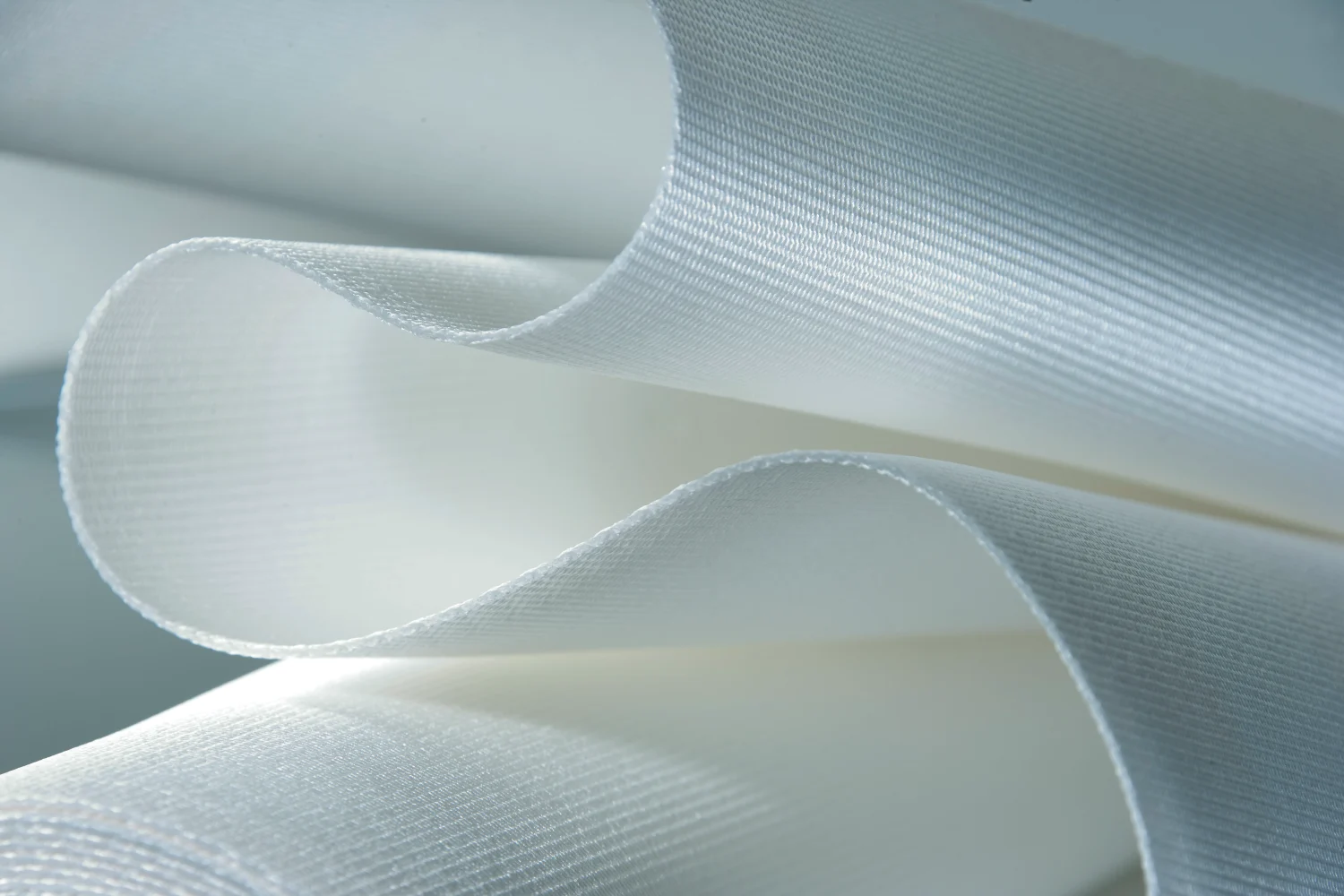
Classification of filter fabrics by yarn type
At Protex Poland, we offer a wide range of filter fabrics adapted to various industrial applications. One of the key criteria for selecting fabrics for the filtration medium is the type of yarn used, the weaving pattern and the method of surface finishing, thermal stabilization and calendering to achieve the proper structure of the fabric application. We distinguish three basic groups:
1. Monofilament fabrics (MO/MO)
Built entirely from single, smooth fibers (monofilaments).
Characteristics:
- Rigid structure with regular, uniform satin weave
- High air and liquid permeability – lower filtration resistance, shorter dewatering cycle time and effectively easy cake release
- Easy cleaning of surface structure and unblocking of porosity
- Good resistance to abrasion, stretching and elongation
Applications:
- Filtration of sludges, suspensions in chamber and membrane presses
- Chemical industry, mining, sewage treatment plants
- Where filtration speed and possibility of long operation are important
2. Multifilament fabrics (MU/MU)
Made from multi-filament yarn consisting of many thin elementary fibers woven together in the transverse and longitudinal directions.
Characteristics:
- Excellent ability to retain fine particles, high filtration quality
- Very dense structure, larger specific surface area of fibers, very small porosity of cross-sectional structure
- Soft, flexible structure – adapts well to filter shapes
Applications:
- Filtration of sludges with low selectivity and high water content
- Chemical, pharmaceutical, food industries, electroplating
- Where filtration accuracy and high particle retention are crucial
3. Mono-multifilament fabrics (MO/MU)
Combine the advantages of both yarn types – one thread in the longitudinal direction (warp) is a monofilament, and the other in the transverse direction (weft) is a multifilament.
Characteristics:
- Balanced compromise between permeability and filtration accuracy
- Better mechanical resistance and better filtration efficiency than mono/mono fabrics
- Moderate stiffness, good performance properties in various conditions
Applications:
- Universal filtration applications for various media and process conditions
- Industries: metallurgical, chemical industry, technological wastewater treatment plants, wastewater from painting processes
- Works well in situations where flexibility and efficiency must go hand in hand
Selection of appropriate fabric type
The choice between mono, multi and mono-multi depends on:
- type and chemical composition of the filtered medium,
- size of filtered particle fractions, temperature and pH of suspension
- Easy cleaning of surface structure and unblocking of porosity
- type of filter and filtration installation, capacity, surface area and filtration efficiency
Our Filter Partition applications provide significant savings in filter fabric costs, as well as increased efficiency through more durable fabric, greater filter efficiency and more reliable operation.
With the tightening of environmental protection regulations and growing requirements for waste and wastewater filtration, filter fabrics must be increasingly durable and reliable, enabling filtration of various types of sediments and particles of different sizes.
Our specialists will help in selecting the optimal fabric in terms of technical parameters, durability and operating costs. Protex Poland offers the widest range of high-quality filter fabrics on the market, as well as technical support ensuring optimal performance.
Filter screens made of monofilament fibers
- Filter screens with different mesh openings and slot ratios
- Screen art. SP10, SP12, SP14, SP16 — braid made of polyamide (PA6), used for deep wells as a filter surrounding deep pumps.
- Dense rep weave effectively stops sand, silt and contaminants, protecting the pump from silting and damage.
- Available in widths ~110 cm and 145 cm, from roll by meters — different filtration levels.
- Ensures long-term and stable well operation, extends pump operating life and reduces failure rates.
Get a personalized offer
Our team of experts will answer all your questions and advise you on the best solution for your business.